
by Brad Mikes, Founder & Managing Partner, IPE
2109 words – 9 minutes read time
Visibility and Transparency Drive Increased Productivity and Efficiency
Shop floor control (SFC) helps furniture manufacturers improve productivity, control costs and make better use of labor and production capacity. By providing greater visibility and actionable insights, SFC helps manufacturers identify bottlenecks, improve efficiency, manage quality and repairs, and make faster, better-informed decisions.
Key Considerations
Furniture manufacturing is a complex business, with many interconnected processes, many of which require highly skilled labor. Depending on the product, production often includes frame building, cutting, sewing, cushion preparation, upholstery, finishing and assembly. A delay in one operation affects the work that follows.
At the same time, there is pressure to improve productivity, control costs, and meet customer expectations. U.S. Bureau of Labor Statistics data show that labor productivity in the furniture manufacturing sector declined 4.1% in 2025, while unit labor costs increased 5.7%.
For furniture brands, factory operations must be as finely tuned as a symphony orchestra. After all, production must support priority No. 1: end consumer satisfaction. Shoppers expect furniture to meet standards for quality, appearance and performance, whether they are purchasing an affordable piece or investing thousands of dollars in a high-end custom product. Meeting those expectations requires coordination throughout the business, from the shop floor to the showroom.
That is why leading furniture brands such as Century Furniture have invested in IPE’s IP-Realtime shop floor control system—to gain greater transparency into production and the information needed to improve efficiency and make better-informed decisions.
Traditional vs. SFC-Enabled Manufacturing
| Traditional Process | SFC-enabled Process | |
| Product Information | Paper records, spreadsheets and whiteboards | Current, accurate digital information |
| Problem identification | Problems may be identified after delays occur | Earlier visibility into potential problems |
| Performance Measurement | Manual compilation of metrics | Real- or Near-real-time performance information |
| Order Management | Walking the floor for manual updates | Quick, complete visibility into order status/progress |
| Line Balancing | Rely heavily on observation and experience | Data identifies workable imbalances |
| Employee Engagement | Information may be delayed or fragmented | Employees access current production information |
| Team Engagement | Information may be unavailable or delayed | Teams view always up-to-date information |
| Management Decisions | Rely on incomplete, outdated information and instincts | More timely, data-driven decisions based on current production conditions |
Top 5 Benefits of Shop Floor Control

1. Boosting Productivity and Agility
Productivity is one of the most tangible reasons furniture manufacturers consider SFC.
An operator may be waiting for a frame, cushion, fabric or other component. A sewing operation may fall behind the schedule needed by upholstery. One work center may have available capacity while another becomes a bottleneck.
Without timely information, these problems are difficult to see.
SFC captures production activity and makes that information available immediately. With production rates, including operator and team performance, managers can quickly identify areas where-ways-shop-floor-control-is-transforming-furniture-manufacturing productivity lags.
The goal is not to find fault; rather, to understand how the production system is performing and where time and capacity are being lost.
This plant-wide perspective distinguishes SFC from investments focused on a single operation. A new machine may improve one process. Production management technology provides information across multiple operations and helps management address problems affecting overall production flow.
Century Furniture identified this plant-wide visibility as one of the greatest benefits of its IP-Realtime™ SFC implementation.
“IPE’s real-time shop floor visibility and operator-level performance metrics have transformed the way we manage our manufacturing operations.”
— Keith Nichols, VP of Manufacturing, Century Furniture
Century reports that access to production information also improved order management and operational efficiency.
Productivity and agility are closely connected. Furniture manufacturers strive to balance available labor against production requirements, but conditions change throughout the week or even a single day. An operator may be absent. One operation may finish work faster than expected. Another may encounter a quality problem, material shortage or equipment issue.
SFC provides the information needed to identify these changes and respond. A data-driven view of what is happening on the production floor emulates and enhances what experienced supervisors and managers deduce with a seasoned eye. Digital information gives people more power to reallocate labor based on current conditions, not outdated reports or visual observation alone. The result is better utilization of available labor and capacity.

2. Reducing Costs Through Efficiency
Productivity and cost control are always intertwined. As every furniture plant manager and executive knows all too well, both undercapacity and overcapacity impact the balance sheet.
Even modest productivity gains enable furniture manufacturers to produce more in less time without immediately adding labor or capacity. IPE customers regularly report productivity increases of 10% or more following their SFC investments.
How is this achieved?
SFC helps identify conditions that consume productive time, including:
- Employees waiting for work
- Production bottlenecks
- Unbalanced production lines
- Excessive work-in-process
- Unplanned, non-productive events (e.g., machine downtime)
- Maintenance delays
- Quality problems and rework
- Manual data-entry tasks
- Delayed responses to production problems
Furniture manufacturing is an interconnected system. Problems rarely stay confined to one work cell, process or department.
If cutting falls behind, sewing may eventually run short of work. If frame production is delayed, upholstery may be idled, and so forth. The opposite also can occur. One department’s output can outpace the next one’s ability to take the baton and run with it. Either way, the result is excess work-in-process without a corresponding increase in finished production.
SFC makes these conditions visible sooner.
“Real-time information helps us avoid bottlenecks and better balance production lines and flow.”
— Tony Hardin, Co-owner, Little Birdie
The practical value is the opportunity to act before a localized problem becomes a larger production problem. Depending on the situation, a supervisor may shift labor, change priorities, address a material issue or adjust the sequence of work.
SFC, on its own, does not automatically reduce costs. Its value comes from helping manufacturers identify sources of lost time, understand their impact and take corrective action.

3. Optimizing Order Management and Workflow
With SFC, manufacturers obtain production information that previously may not have been available at all, or that required manual collection and could not be accessed easily or rapidly. Information that once lived on paper, in spreadsheets or in individual departments comes to light.
That visibility is particularly important for furniture brands that offer custom configurations, such as numerous combinations of fabrics, finishes, dimensions and other specifications. Consumers love this freedom to create just the look they want for their home. Most will pay more for this premium service. But resulting higher margins erode with every productivity loss.
SFC provides a more current view of production activity, including order status, productivity, work-in-process and production progress.
That actionable information helps to answer questions such as:
- Which orders are currently in production?
- Which employees are producing as planned?
- Which work centers are falling behind?
- Where is work in process accumulating?
- Where are production problems occurring?
- Which orders may be at risk of delay?
Long lead times negatively impact customer service. Although manufacturers are no longer dealing with the extraordinary disruptions and market swings of the pandemic period, they still need to spot brewing problems that threaten on-time delivery.
For Century Furniture, real-time visibility and operator-level performance metrics have been particularly valuable. The company reports that immediate access to production information has helped improve operational efficiency and decision-making.
Furniture manufacturers may produce standard products, custom products or a combination of the two. Orders can involve different materials, configurations, production requirements and delivery schedules.
Knowing that an order exists is different from knowing where it is in production.
SFC connects production activity with order information. Managers see whether an order has entered production, where it is in the process and whether it is progressing as expected.
Century Furniture reports that its order management and efficiencies have improved because of IPE’s shop floor control technology. Its experience illustrates how production visibility extends beyond the factory floor and supports broader production management.
Century also integrates IPE SFC with its SAP enterprise resource planning (ERP) system. When an order enters through SAP, relevant information flows into SFC, connecting business and production information rather than leaving it in separate silos.
This type of integration makes information more useful. When systems share relevant data, employees rely less on manual handoffs or recreating information that already exists elsewhere in the business.

4. Empowering the Workforce and Lightening the Administrative Load
Production employees are closest to the work. They often have the most immediate understanding of what is happening at their workstations. Current information helps them understand priorities, production expectations and their own performance.
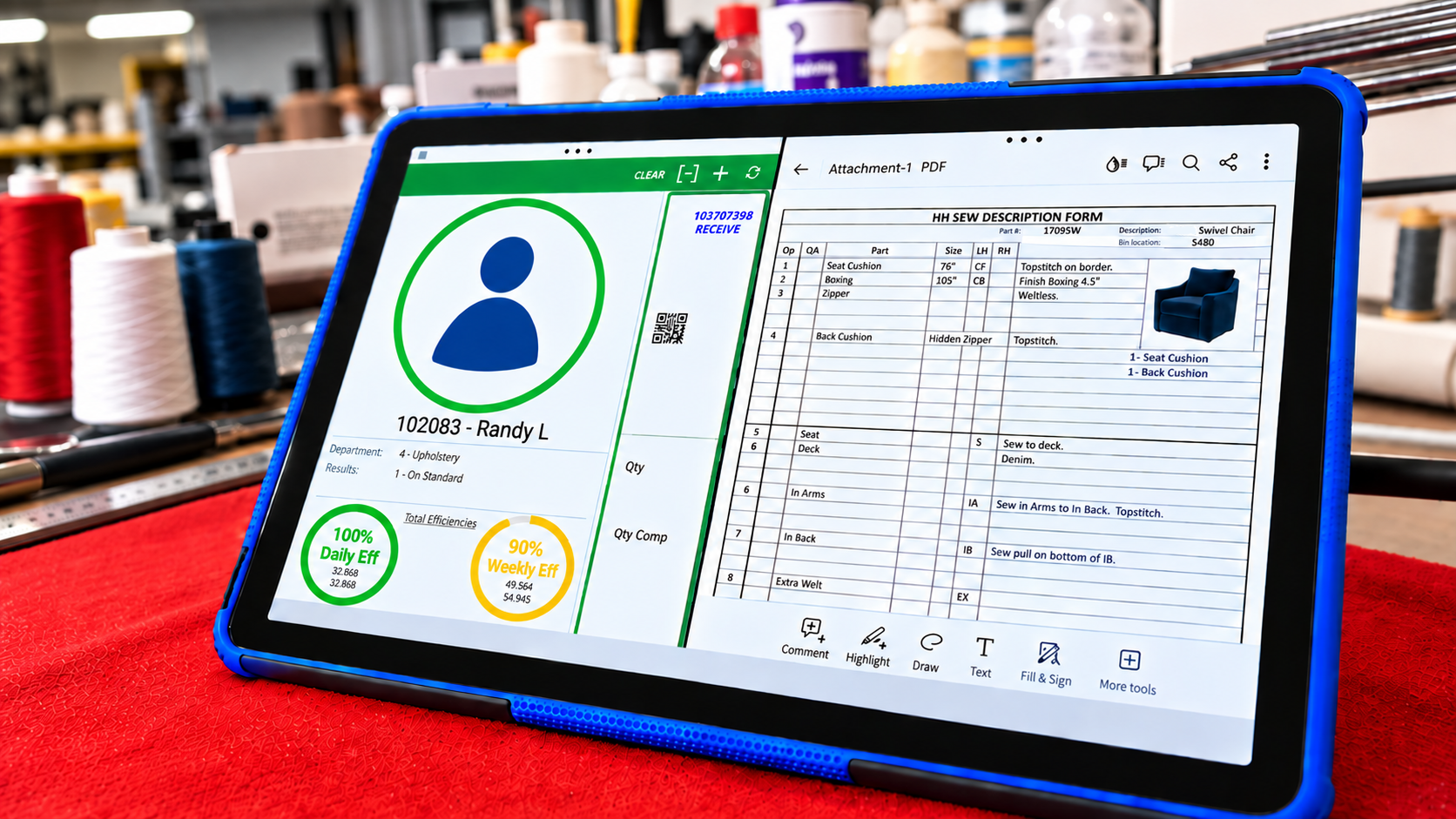
Century Furniture reports that its employees are more engaged because tablets provide better information to help them make decisions during the workday.
“With immediate access to accurate production data, we have improved order management and operational efficiency.
Our employees are more engaged and now make faster, better-informed decisions.”
— Keith Nichols, VP of Manufacturing, Century Furniture
This reflects an important principle of effective SFC. Information should not simply be collected for management reports. It should be useful to the people doing and managing the work.
When employees have immediate access to relevant production and product information, they better understand how their work contributes to the overall operation. For skilled furniture workers — from master woodworkers and frame builders to sewing operators and upholsterers — having information like detailed work instructions, product and assembly images, and real-time productivity feedback at their fingertips helps them perform better and meet production and performance expectations.
Production management involves more than making the furniture. Someone also must collect production information, enter data, track order status and compile reports. SFC automates or simplifies many of these activities by automatically capturing production information digitally as work occurs. The resulting data becomes available for reporting and analysis.
SFC also streamlines payroll processing, whether it is incentive-based or hourly pay. Instead of relying on manual methods to track operator performance and throughput, SFC captures production data electronically and uses it to calculate performance and earnings.
For employees, greater transparency makes it easier to understand how productivity data connects to performance and compensation. For management, automated data collection reduces the time required to reconcile information before payroll is processed.
The benefit goes beyond administrative convenience. When supervisors and managers spend less time collecting and reconciling production information, they have more time to focus on production itself.

5. Managing Quality and Repairs
Boosting productivity also reduces returns when a quality problem sidelines a beautiful piece of furniture.
In some industries, a production problem can affect dozens or hundreds of pieces before anyone discovers it. A machine that skips stitches, for example, could keep producing defective sewn products until an inline quality check identifies the source. Not a good situation.
Quality problems in a furniture plant present a different set of challenges. More often than not, a defect is isolated to a single piece here or there, but over time, it becomes a risk of collateral damage to the business. Manufacturers such as Century Furniture produce high-end products. So when one item sits in the repair queue, it can lead to disgruntled buyers, refund demands, and, worst of all, a loss of trust in the brand.
Unfortunately, the repairs department can become an isolated island while the plant’s resources are focused on the next order. The challenge is knowing what is in that department, why each piece is there, and how much work and value is accumulating.
SFC provides greater transparency into repair activity. On a digital dashboard, management can see at a glance how many pieces are waiting for repair, where they are in the process, and how repairs affect production flow.
The end goal is not simply to track the repair. It is to make sure the piece does not become invisible to the people responsible for managing production.
Better production information does not improve a furniture plant on its own. Its value comes from helping the people
who manage and perform the work see problems sooner, make better decisions and keep production moving.
Conclusion
For furniture manufacturers, the strongest case for SFC is not simply that it replaces paper with digital information. The more important question is what manufacturers can do with better information.
SFC helps manufacturers improve productivity, control costs, increase efficiency, identify bottlenecks, manage production flow, improve order visibility, address quality and repairs, better utilize labor and give employees the information they need to make better decisions.
Technology does not manufacture furniture. People do. SFC provides information that helps those people understand what is happening across the operation and respond while there is still an opportunity to improve the outcome.
For furniture manufacturers looking for practical ways to improve productivity and efficiency while meeting customer expectations, greater visibility into production provides a valuable place to start.

Brad Mikes, Founder & Managing Partner at IPE, has spent the last 35 years solving manufacturing challenges through improved business processes and information technology. He now applies this expertise to furniture, apparel, sewn products, consumer goods, and other labor-intensive manufacturing.
Related Articles:
Why Shop Floor Control Is the Smartest Investment a Manufacturer Can Make
Bad Habits Furniture Manufacturers Need to Break
3 Persistent Problems Furniture Makers are Solving with Technology
